


Atlanta, GA
September 15, 2025
“If money isn't loosened up, this sucker could go down.”
- President George W Bush
Three disasters have defined this century. Each was precipitated, perpetuated, and exacerbated by people who used the crisis to accrue more power.
One calamity occurred as the millennium opened. The next as its first decade ended. And the third as this one started.
Our last installment discussed the initial catastrophe. Today, seventeen years after the Lehman Brothers collapse, we examine some causes and consequences of the second.
Predictable Pile-Up
The multi-decade fight against “terror” has cost trillions of dollars and millions of lives. Congress never declared these wars, which were funded by fake money counterfeited by the Fed.
This financial finagling precipitated a predictable pile-up on this century’s road to perdition. As with any economic event afflicting billions of people, the 2008 financial crisis had many causes. But the main impetus was the Federal Reserve.
Under sound money, business cycles always occur within specific companies or industries. But they’re relatively contained.
For a given product or particular market, desire ebbs and favor flows. Supply and demand wax and wane with resource constraints, competitive pressure, customer preference, and price extremes that cure themselves.
But for the entire globe to crest and crash on the same wave means an exogenous force caused a raucous wake. Widespread booms and busts… including the Great Depression and the stagflationary Seventies… have been more extensive and severe since the founding of the Fed.
But the two decade “Great Moderation” after the early ‘80s “Volcker shock” seemed to tame the business cycle. With his Black Monday bailout in 1987, Alan Greenspan created his eponymous “put” that made him the “maestro”.
The Fed has repeatedly reprised his tune throughout this century. That makes sense. Counterfeiting is the only song they know. Like day drinking, speaking two languages, and tax avoidance, ripping people off is cool if you’re rich but can cause problems if you’re poor.
As David Stockton notes, the Fed balance sheet (the amount of money it’s conjured) increased 35-fold since the advent of the “Greenspan put”. Nominal GDP merely quintupled, with real GDP up only half that much.
After the tech bubble burst, the Fed did what it always does: created a new one. Greenspan again rode to the “rescue”.
Primary Accomplices
Like a beach ball under water, the Fed forced interest rates below the level at which they’d have naturally floated. When markets made them let go, everyone got soaked.
In a startling move at the time (tho’ in retrospect it seems like quaint restraint), Greenspan held rates at one percent for over a year. The result was the only recession on record in which house prices didn’t fall. From that “lesson”, politicians and bureaucrats encouraged borrowers to believe they never would.
During the first seven years of this century, more dollars were created than in the previous two centuries combined. In subsequent years, that ignominious record would be repeatedly eclipsed.
Much of this money flowed into mortgages, precipitating an unnatural rise in real estate prices (which was the idea). Easy credit attracted marginal speculators who had no business being in the market.
Not that the Fed didn’t have help. Among its primary accomplices were a couple privileged, state-sanctioned ambiguities known as Fannie Mae and Freddie Mac.
These “Government Sponsored Entities” (GSE) purchase mortgages on the secondary market. With an implicit taxpayer backstop, they buy loans from originators, which provides those lenders additional funds to extend new loans.
This process prompts more mortgages than would otherwise exist, making it easier for people to “buy” homes they can’t afford. Government laid the bait that lulled buyers into this trap.
The tax and regulatory benefits GSEs enjoy, plus an essentially unlimited line-of-credit from the U.S. Treasury, diverted resources and distorted markets by allowing these entities to raise money and buy mortgages more easily than private competitors could.
Under political pressure to increase home “ownership” among “disadvantaged” groups, GSEs also enabled lower lending standards by easing requirements on mortgages they bought. This encouraged more reckless loans, as originators knew they could offload them from their books.
Much as student loans and lower admission standards enticed millions into college who had no business being there, the Fed, GSEs, and crony legislation like the Community Reinvestment Act (CRA) and Equal Opportunity Credit Act attracted borrowers into mortgages they would never be able to afford.
“Generally Sound”
As Tom Woods noted in Meltdown, his definitive overview of the financial crisis, even the New York Times conceded these warped interventions “changed homeownership from something that secured a place in the middle class to something that ejected people from it.”
Loose money and low standards (a natural consequence of loose money) affected prime loans too. In many cases it infected them first, and more quickly… which undermines the notion that lenders “preyed” on subprime borrowers.
Adjustable rate mortgages enticed creditworthy speculators and “flippers” to borrow more than they otherwise would. This allowed them to bid up prices, enjoy appreciation, and sell the property before teaser rates rose… all of which attracted more speculation.
This is what the government wanted. For two decades, both political parties, including President George W Bush, urged down payment requirements be subsidized, reduced, or ditched.
As these wishes were increasingly accommodated, Greenspan’s successor, Ben Bernanke, assured us “lending standards are generally sound.” The year George Bush asked lenders to dispense with down payments, the Fed dismissed the idea there was a housing bubble.
Former Chairman Greenspan encouraged borrowers to take advantage of adjustable rate mortgages (without warning that the adjusted rates would eventually take advantage of them).
And why not? For two decades the Fed had implicitly enticed (and explicitly backstopped) reckless behavior its counterfeiting encouraged. As the housing bubble inflated, the people pumping air lamented a lack of affordable homes.
When the burst bubble finally offered the remedy, lower prices became the one tonic that wasn’t allowed. The people who caused the problem promptly pumped more of the debt and bailouts that produced the binge.
To the extent these “saviors” were criticized, it was for being too slow and stingy pouring the booze. As the hangover intensified, the bartenders decided to open the taps.
A Vietnamese Village
By March 2008, the investment bank Bear Stearns was essentially a tomb for mortgage-backed securities. Rather than bury Bear, the Fed “bought” it… and handed the casket to JP Morgan.
Within months, more institutions stumbled toward the grave.
In early September, Fannie and Freddie were nationalized. Without any Constitutional authority or consultation with Congress, the U.S. Treasury took over most of the mortgage market.
Treating the economy like a Vietnamese village, President Bush said “I’ve abandoned free-market principles to save the free-market system". The government continued to coat the economy with monetary napalm.
But seventeen years ago today, even the blind nut found a squirrel. The week after Fannie and Freddie were taken over, the authorities unwittingly did the right thing. Lehman Brothers was allowed to go bust. About the same time, Washington Mutual was liquidated.
In each case, good assets were acquired by others; bad ones went away. That’s the way bankruptcy is supposed to work. But the anomaly didn’t last.
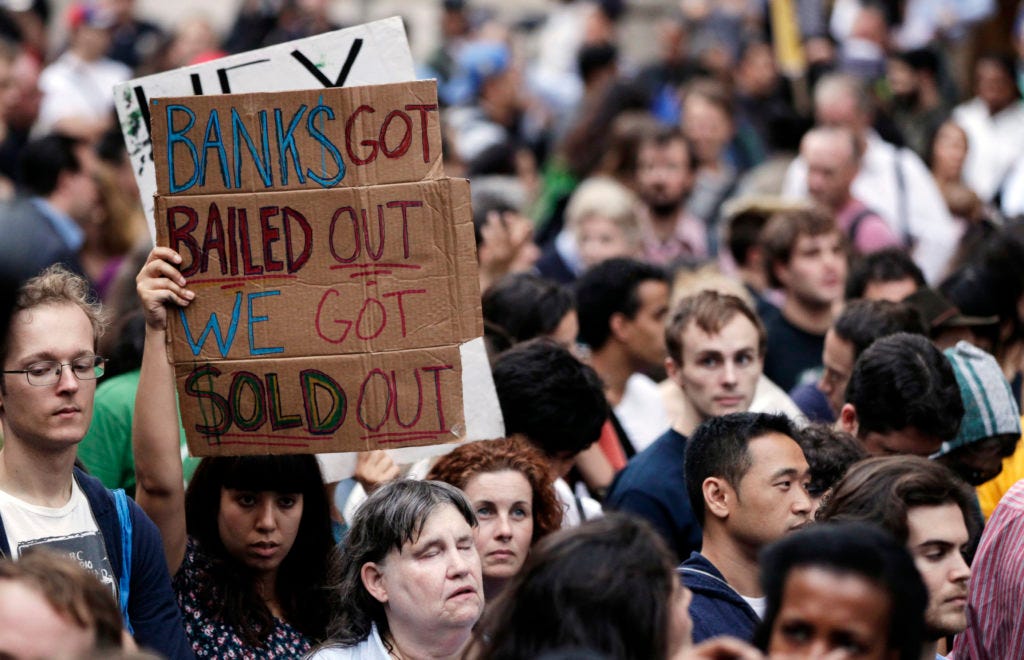
The day after Lehman fell, the government bailed out AIG… and, by extension, the investment banks its credit default swaps “insured”. The Fed lent the company $85B in exchange for 80% ownership. Six weeks later, it loaned another $40B.
Anyone can make a mistake. But for a real disaster you need the government. It isn’t good at much. Yet one thing it’s great at is causing problems, then using those as reasons to stoke panic, instill urgency, compound power, and impose “solutions” that magnify the mess.
By the end of September, that skill was brought to bear. Americans were warned that without a massive bailout of Wall Street banks, small businesses would fail, the economy would collapse, and retirement plans would be wiped out.
Left unsaid was that throughout the “crisis” creditworthy borrowing kept occurring, albeit at a reduced rate and higher risk premium. That’s as it should be.
No Economy on Monday
The fake boom was the disease; the inevitable bust is the cure. As during the forgotten Depression of 1921 (which was sharp yet swift because bureaucratic “experts” did nothing), liquidations need to run their course.
In times of uncertainty after distortions caused by cheap “money”, tighter credit is what’s needed. Time is too, so malinvestments can be washed away and prices find their natural level. Patience is a virtue… something our “leaders” usually lack.
Over that September weekend when the heist was being planned, Ben Bernanke warned that “if we don’t do this [bailout] today, we won’t have an economy on Monday”. It was absurd… as if all private exchange would cease unless taxpayers were stuck with the bad loans of bankers this package would reward with bonuses.
The Troubled Asset Relief Program (TARP) authorized the Treasury to spend up to $700B (a quaint tab now, but an astonishing sum at the time) to essentially buy any asset it wanted at whatever price it demanded. Those who resisted this larceny were ridiculed as ignorant ideologues who don’t appreciate the vaunted “expertise” of their bureaucratic betters.
Yet most of the “experts” were sharp as bars of soap. Among their idiotic ideas was a ban on short-selling, which had the effect of pulling a safety net from under the market. Much as not allowing businesses to bar certain races inhibits customers from identifying bigots in their midst, prohibiting short-selling removes a signal revealing which companies are less likely to be sound.
Because they must eventually buy the shares they initially borrowed, short-sellers also put an implicit floor under falling markets. Banning the practice is like replacing a trampoline with a trap door.
None of these “emergency measures” were necessary, and only exacerbated problems they purported to fix. A Federal Reserve Bank of Minneapolis study showed that whereas Wall Street banks had trouble borrowing (for good reason), business, consumer, and inter-bank loans hardly declined.
The “credit crunch” was confined mostly to crony banks craving taxpayer cash to stay afloat. We were warned that letting them drown would pull us all under water. The government had no choice but to give them our boats.
Taxpayers were buffeted by waves of alphabet programs that facilitated the looting. The Term Auction Facility (TAF), Term Securities Lending Facility (TSLF), and Primary Dealer Credit Facility (PDCF) were among the boondoggles that ripped them off to prevent connected firms from failing.
Rotting Planks
Setting a precedent that persists today, the government sought to buy stock in these corporations. As Hugo Chavez mocked, “Comrade Bush announced he will buy shares in private banks. … He is to the left of me.”
The share purchases were orchestrated thru a new Office of Financial Stability (as Woods quipped, “what would a new government agency be without an Orwellian title?”), which would force even healthy banks to accept government money for the good of “the system”.
But there was little good about “the system”. At its core is the Federal Reserve, without which the crisis couldn’t have occurred. Yet not only was the Fed rarely fingered as a culprit, it was regularly praised as the savior.
The usual suspects were arraigned instead: “tax cuts”, “deregulation”, and insufficient power of government officials to push the rest of us around. To “rectify” this, new agencies and edicts were propagated, by people who neither saw the crisis coming nor had a clue what caused it… while dismissing those who did as cranks and quacks.
Rather than allow the economy to purge the distortions and excesses that made it sick, they hopped behind the bar and began mixing more drinks. Anything to avoid last call.
The Fed was hellbent on keeping the sun from coming up. Making his predecessor look stingier than Shylock, Ben Bernanke dropped the fed funds rate to zero… where it sat almost a decade.
He implemented quantitative easing by buying government bonds and mortgage backed securities with currency conjured from thin air. Even foreign institutions were bailed out with money inflated away from American wallets.
Superficially, these measures seemed to “work”. For their intended beneficiaries, they did.
With historic infusions of cash, panic subsided, markets reversed, and bonuses were paid. But beneath the shiny veneer remained rotting planks. On their underside, weevils and beetles continued to bore.
They’d do so for a decade, till the next cataclysm blew out the boards.
JD
As Rothschild once remarked “Give me control of the supply of money and I care not who is in charge.”
Unfortunately, arrogance has its consequences!
There’s a wind of change blowing!
Got gold?
And is it beyond the reach of the arrogant and greedy ones?
As The threat of counterfeit U.S. currency to the financial system of the United States continues to evolve. Advances in technology, the availability of scanning and printing devices and the adoption of the U.S. dollar by nations as their legal tender have exacerbated the global threat. This threat is in direct competition with the Federal Reserve. The largest counterfeiting operation the world has ever seen….